



Quick answer: Poor policy management in GRC costs money in ways that never show up as a line item. Audit rework, legal exposure, staff confusion and duplicated effort all get absorbed into normal operating expense. Fix acknowledgement tracking and version control, and most of that cost becomes recoverable within a single review cycle.
If you asked your CFO what your policy library costs to maintain, the honest answer would probably be close to nothing. A shared drive, a few hours of someone's time each year, maybe a template pack bought once and never revisited.
That answer is wrong, and the gap between the stated cost and the real cost is where the problem lives. The expensive part of policy management is not writing the policies. It is what happens when nobody can prove who read them, which version applied on a given date, or when the document was last reviewed.
The controlling idea of this article is simple. Poor policy management in GRC is expensive in ways that never appear on a budget line, and the cost is recoverable once acknowledgement and version control are fixed. This is a companion piece to Sentrient's original article on policy management in GRC, which sets out the full lifecycle argument. This version follows the money.
Why Is Poor Policy Management In GRC So Expensive?
Because the cost is diffuse. It arrives as extra hours, not as an invoice.
The best available benchmark comes from the Ponemon Institute and GlobalScape study The True Cost of Compliance, which found non-compliance costs organisations about 2.71 times more than compliance. In dollar terms the study put non-compliance at an average of US$14.82 million a year against US$5.47 million for maintaining compliance. Those are large-organisation averages and they are not an Australian figure, so treat them as a ratio rather than a forecast. The ratio is the useful part.
Scale that ratio down to a business of 120 people and it still holds a shape you will recognise. Every hour spent reconstructing an audit trail is an hour not spent on client work. Every policy dispute that turns on which version an employee saw is a legal cost that a signature record would have avoided.
The market has noticed. The APAC GRC market passed US$9.2 billion in 2025 according to 6clicks, with Australia and New Zealand named as the primary regulatory driver. Businesses are not buying GRC tooling because it is fashionable. They are buying it because the manual version stopped being cheap.
What Does A Failed Audit Actually Look Like In An Australian Business?
It looks like six weeks of unplanned work and a very uncomfortable board meeting.
Here is a pattern we see often enough that it is worth setting out in detail. A Melbourne-based professional services business of around 140 staff went into a client-mandated compliance audit expecting a formality. They had policies. They had a WHS policy, a privacy policy, a code of conduct, a bullying and harassment policy. All of them existed. All of them were in a folder on SharePoint.
The audit did not fail because the policies were bad. It failed because the business could not evidence three things. It could not show which version of the code of conduct was current at the time of a grievance raised eight months earlier. It could not produce acknowledgement records for roughly a third of staff, mostly people who had joined in the previous eighteen months. And it could not demonstrate any scheduled review had occurred since the documents were first drafted.
The consequences ran further than the audit report. The operations manager and two team leads spent the better part of six weeks reconstructing records, chasing signatures retrospectively and rebuilding a version history from email attachments. The client contract renewal was held for a quarter pending remediation. External advice was engaged on two of the policies. None of that appeared as a policy management cost. It appeared as overtime, as legal fees, as delayed revenue.
The fix took far less time than the failure. They moved to a system where every policy has an owner, a version number, a distribution list and a review date. New starters receive their policy set as part of onboarding. Acknowledgement is captured at the point of reading, not chased afterwards. Their next audit took four days of preparation instead of six weeks.
What Is The Real Cost Comparison Between Poor And Managed Policy Management?
Set the two states side by side and the recoverable cost becomes visible.
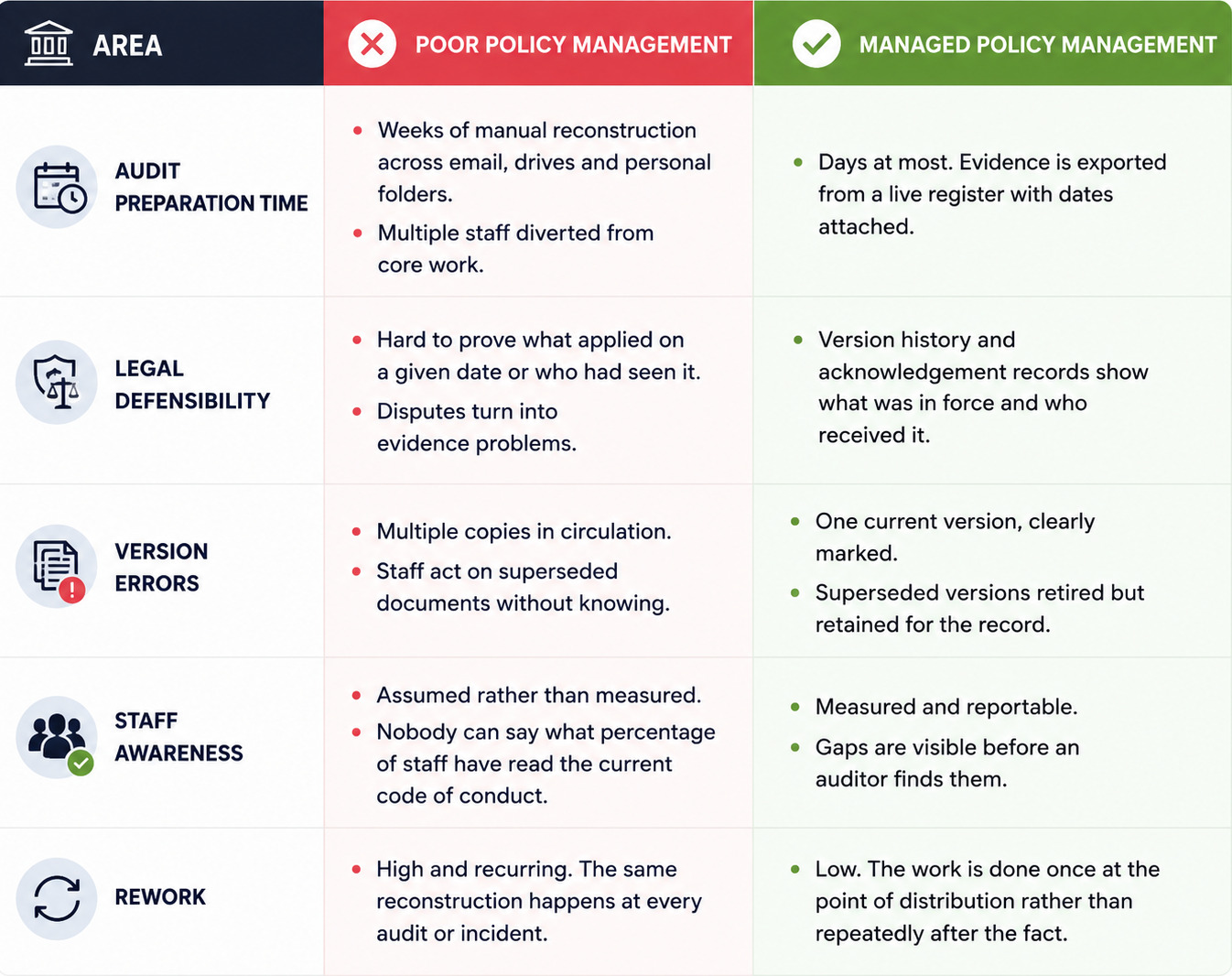 The rework row is the one finance leaders tend to react to. Reconstruction cost is not a one-off. It repeats every time someone asks a question the records cannot answer.
Why Does Acknowledgement Matter More Than The Policy Document?
Because acknowledgement is what turns a document into a control.
A policy sitting in a shared drive is a statement of intent. A policy that has been version-controlled, distributed, acknowledged and reviewed on schedule is evidence that the intent was operationalised. Governance sets direction, risk identifies what could go wrong, and compliance proves obligations were met. Policies plus acknowledgement records are the connective tissue between all three.
There is a persistent problem with assuming staff have read what you sent them. A GuideSpark survey reported that 43% of millennial employees said they had not read most of their staff handbook. That figure is dated, it is US-based, and it should be read as illustrative rather than as a current Australian measure. It is worth mentioning only because it matches what most HR leaders find when they actually check.
The Australian regulatory context makes this concrete. An APP-compliant privacy policy is a legal requirement under the Privacy Act, as set out in the OAIC's Australian Privacy Principles. Documented WHS policies and procedures form part of demonstrating duty of care under Safe Work Australia's Model Codes of Practice. And record-keeping failures carry infringement notices and penalties under the Fair Work Ombudsman. In each case the existence of the document is only half of what is being asked for.
How Do You Fix Policy Management Without Rebuilding Everything?
Start with the two things that produce the most evidence for the least effort, which are acknowledgement tracking and version control.
A practical sequence that works for most mid-sized Australian businesses:
- Inventory what exists. Every policy, where it lives, who owns it, when it was last reviewed. Expect this to be uncomfortable.
- Retire duplicates. If three versions of the same document are in circulation, decide which one is current and formally retire the rest rather than deleting them.
- Assign an owner and a review date to every surviving policy. A policy without an owner will not be reviewed.
- Distribute the current set with acknowledgement capture, and build the same step into onboarding so new starters are never the gap.
- Report on the gap monthly. Awareness you cannot measure is awareness you cannot evidence.
This is where a system earns its place. Sentrient's Workplace Compliance System brings policy distribution, acknowledgement records, version history and scheduled reviews into one place, so the evidence is produced as a by-product of normal operation rather than assembled under pressure. It is Australian built and owned, used by more than 1,000 Australian organisations, and most deployments are operational within about seven days. It supports your compliance obligations and makes the evidence easier to produce. It does not remove the obligation itself, and no system can.
What Should A Board Or Finance Lead Ask For?
Ask for four numbers rather than a reassurance.
- What percentage of current staff have acknowledged the current version of each core policy.
- How many policies are past their scheduled review date.
- How long it would take to produce a full acknowledgement report for the last two years.
- Which policies have no named owner.
If those four questions take more than an hour to answer, the cost described in this article is already being paid somewhere in the business. It is just not labelled.
Bringing It Together
The expense of weak policy management does not sit in the marketing budget or the compliance budget. It sits inside overtime, inside legal advice, inside delayed contracts and inside the quiet rework that happens every time someone cannot prove what was in force and who knew about it.
That expense is recoverable. Not by writing better policies, but by fixing the two mechanisms that make policies provable. Version control tells you what applied. Acknowledgement tells you who knew. Together they convert a document library into a defensible control environment, and they take the audit scramble off the calendar for good.
If you want to see what that looks like in practice, book a free demo and we will walk through your current policy set, show you where the evidence gaps sit, and share our policy management readiness checklist so you can run the same review internally whether or not you go any further with us.
Frequently Asked Questions
1. What is policy management in GRC?
Policy management in GRC is the full lifecycle of a policy, covering drafting, approval, distribution, acknowledgement, version control, scheduled review and retirement. It connects governance direction and identified risks to evidenced practice, so obligations can be demonstrated rather than assumed when an auditor or regulator asks.
2. How much does poor policy management really cost?
The cost is mostly hidden inside other budget lines. Ponemon Institute and GlobalScape found non-compliance costs around 2.71 times more than compliance. In practice most businesses see it as audit rework, legal advice, delayed contracts and staff hours spent reconstructing records that should have existed already.
3. Is a policy in a shared drive good enough for an audit?
Usually not. Auditors ask what version applied on a specific date and who had acknowledged it. A shared drive rarely answers either question reliably. Storage is not the same as distribution, and distribution is not the same as evidenced acknowledgement, which is what most audit findings turn on.
4. How often should workplace policies be reviewed?
Set a scheduled review date for every policy, commonly annually for high-risk areas such as WHS, privacy and conduct, and every two years for lower-risk ones. Also review after any legislative change, restructure or incident. A policy without an owner and a review date will quietly go stale.
5. Can software guarantee our organisation is compliant?
No, and be cautious of anyone claiming otherwise. Software supports compliance by making distribution, acknowledgement, version history and review scheduling easier to run and easier to evidence. The obligations remain with the organisation, and legal advice is still needed for your specific circumstances.