


 Quick answer: A 360 degree performance review is only worth the time you put into it when the feedback leads to action. A survey-only process gathers input from managers, peers and direct reports, produces a report, and then stops. The cost is the whole investment, because you pay for everyone's hours and change nothing. The fix, a complete process with objectives, analysis, development plans and follow-up, costs far less than the waste it prevents.
The question every HR director eventually asks
How many hours did your last review cycle burn, and what actually changed because of them?
For most Australian businesses, the honest answer is uncomfortable. A 360 degree performance review pulls in feedback from a manager, a handful of peers and a few direct reports for every person reviewed. Multiply that across a team, add the time to chase responses and format the reports, and you have spent real money before anyone reads a word. If nothing changes after that, the money is gone and so is the goodwill.
This is the trap of the survey-only 360. The tool collects feedback beautifully. It does not turn feedback into better performance. That gap is where the cost lives, and it is the gap this article is about. The controlling idea is simple. The cost of a survey-only 360 degree performance review is the whole investment wasted, because you pay for everyone's time to give feedback and then change nothing. The fix is cheaper than the waste.
This is general information and not advice for your specific situation. Results vary by organisation, culture and how consistently the process is run.
What is a 360 degree performance review really measuring?
A 360 degree performance review gathers feedback about one person from several sources around them. The point is a fuller picture than a single manager can give. Peers see collaboration. Direct reports see leadership. The manager sees delivery. Put together, the view is more balanced and harder to dismiss.
The measurement only matters if it drives a decision. Feedback that sits in a PDF measures nothing that changes behaviour. Feedback that feeds a development conversation and a plan measures growth over time. Same data, two very different returns.
Why does a survey-only 360 waste the whole investment?
A survey tool does one job. It collects. That is useful and it is not enough. When collection is the whole process, four failures show up almost every time.
- Data without action. Reports get produced and filed. No objective was set at the start, so no decision follows at the end.
- Survey fatigue. People fill in long forms for colleagues year after year, see nothing come of it, and start clicking through to be done.
- Bias and no context. Raw scores with no framing invite defensiveness. A low number with no conversation lands as an accusation, not a chance to improve.
- No change in performance. Without follow-up, last year's feedback and this year's feedback look the same, because nothing was done between them.
Gallup found that only 14% of employees strongly agree the performance reviews they receive inspire them to improve. That figure is the headline cost of getting it wrong. You can run a technically perfect survey and still land in the 86% who feel nothing.
What does getting it wrong actually cost?
Here is the difference between a survey-only 360 and a complete process, area by area. The numbers a business would attach to these rows are illustrative and depend entirely on your size and salaries. The pattern, though, is consistent.
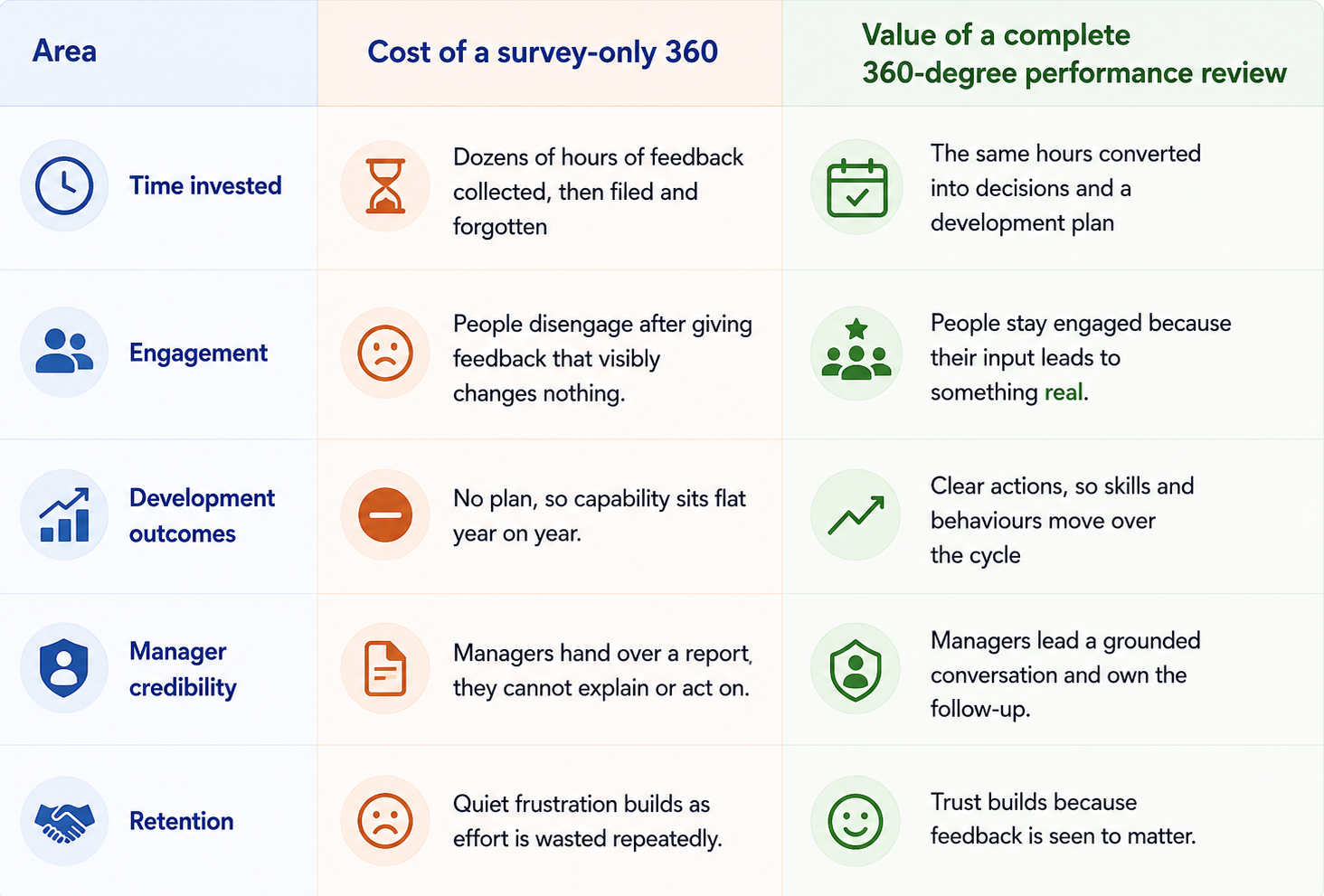 The through line is that every cost on the left is money already spent. You do not save it by cancelling the review. You save it by finishing the process you already started.
How does daily feedback change the maths?
Timing is part of the cost too. Gallup found that employees who receive feedback daily rather than annually are 3.6 times more likely to strongly agree they are motivated to do outstanding work. A once-a-year 360 that produces a report and no ongoing conversation misses that entirely. The point is not to run the formal review more often. It is to make sure the review starts a rhythm of feedback and follow-up rather than ending one.
Gallup has also reported that only about two in ten employees strongly agree their performance is managed in a way that motivates them. That is the size of the opportunity sitting inside a process most organisations already pay for.
What does the fix look like in practice?
A complete 360 degree performance review runs as a loop, not a form. Four stages carry the weight.
- Set objectives first. Decide what the review is for before you send a single question. Development, promotion readiness, a specific capability. The purpose shapes everything after it.
- Analyse, do not just report. Look for patterns across sources, weigh context, and separate signal from one person's bad week.
- Build a development plan. Turn the analysis into two or three concrete actions with owners and dates. This is the step survey-only processes skip.
- Follow up. Revisit the plan through the cycle so the next review measures progress, not a fresh start.
This is where the right software earns its place. Sentrient's 360-degree feedback system supports collecting feedback from multiple sources, analysing it in one place, and tracking the development actions that follow. To be clear about scope, the software supports the process. It does not replace the manager conversation, which is where most of the value is created.
Sentrient is Melbourne-based, Australian built and owned, and supports more than 1,000 organisations across Australia and New Zealand. The platform is designed around the whole loop of collecting, analysing and acting on feedback, because the collecting on its own is the part that quietly wastes money.
What proof should you look for before you trust the process?
Ask three questions of any 360 you run. Did we set an objective before we started? Did every report lead to a written plan? Did we check on those plans before the next cycle? If the answer to all three is yes, the hours you invested are working. If any answer is no, that is exactly where the cost is leaking, and it is a cheap thing to fix compared with the effort already spent.
You can read the fuller argument for why collection alone falls short in the original Sentrient piece on 360 degree performance review practice.
The bottom line
A survey tool is not the problem. Treating collection as the finish line is. The feedback has already cost you the hours. Analysis, a plan and follow-up cost a fraction more and are the only part that returns anything. Finish the process and the investment starts paying you back instead of quietly draining away.
If you want a head start, book a free demo and ask to see how the platform turns collected feedback into development plans and follow-up. It is the cheapest way to stop paying for reviews that change nothing.
Frequently Asked Questions
1. What is the difference between a survey tool and a 360 degree performance review?
A survey tool collects feedback and stops there. A 360 degree performance review is a full process that sets objectives, gathers multi-source feedback, analyses it for patterns, builds a development plan and follows up. The tool is one part of the review, not the whole of it.
2. Why do survey-only 360 reviews fail to improve performance?
They collect data without acting on it. No objective is set at the start, so no decision follows at the end. People experience survey fatigue, scores arrive without context, and nothing changes between cycles. The feedback is gathered and then filed, so behaviour stays exactly where it was.
3. How often should a 360 degree performance review run?
The formal review commonly runs once or twice a year, but the feedback habit should be continuous. Gallup found employees who receive feedback daily rather than annually are far more likely to feel motivated. Use the formal cycle to start an ongoing rhythm of feedback rather than a single annual event.
4. Can software run a 360 degree performance review on its own?
No. Software supports collecting, analysing and tracking feedback and development actions in one place, which removes the manual load. It does not replace the manager conversation, where context is added and plans are agreed. The value comes from the process and the people, with software making that process easier to run well.
5. How do you measure the return on a 360 degree performance review?
Check whether each review set an objective, produced a written development plan, and had those actions followed up before the next cycle. Progress against those plans is the return. If reviews generate reports but no plans or follow-up, the hours invested are producing data instead of improvement.