



Quick answer: Psychosocial risk management is identifying, assessing and controlling the workplace factors that cause psychological harm, using the same lifecycle you already apply to physical hazards. Reactive approaches wait for a claim or a complaint before acting. That is the most expensive way to run it. Preventive psychosocial risk management fixes the root causes, such as workload and exposure to bullying, and costs a fraction of what a serious mental health claim costs in human harm, lost time and higher premiums.
Every business owner and CFO eventually asks a version of the same question. Is it cheaper to react to psychosocial issues when they surface, or to prevent them at the source? Before the money, though, sits the part that matters most. Psychological injury is real injury. It takes people away from work and away from their lives for a long time, and it affects families, not just balance sheets. So the honest answer starts there. The human cost of getting this wrong is high, it lands on real people, and it is largely preventable.
Once you hold the human cost first, the financial and legal case follows cleanly. Reactive psychosocial risk management, waiting for a claim or a complaint, is the most expensive way to run it, because prevention at the source costs far less than a mental health claim in harm, absence and premiums. This article walks through what the cost of getting it wrong looks like, and then the fix.
This is general information, not legal advice. For obligations specific to your business, seek advice from a qualified professional.
What is psychosocial risk management, and why treat it as risk not just wellbeing?
Psychosocial risk management treats mental health risks like any other workplace risk. You identify the hazards, assess who is exposed and how badly, control the risk at the source, and then review whether the control worked. It is the physical-hazard risk lifecycle, applied to factors such as high workload, low job control, poor support, bullying and harassment.
The reason it sits under risk, not just wellbeing, is that it is now a compliance obligation. The model WHS Regulations were amended in June 2022 to require managing psychosocial risks, according to Safe Work Australia. Wellbeing programmes are welcome. They are not a substitute for a structured risk process, and a regulator will look for the process, not the perks.
What does getting psychosocial risk wrong actually cost?
Start with the human cost, because it is the largest and the least reversible. A psychological injury keeps a person away from work for a long time. According to Safe Work Australia, a mental health claim takes a median of 35.7 weeks off work, almost five times the median for other injuries. That is the better part of a year, often longer, spent recovering. The people around that person feel it too.
Then comes the financial cost. Safe Work Australia reports median compensation of about $67,400 per mental health claim. Mental health conditions are roughly 12 per cent of serious claims but account for a larger share of total cost, because each claim runs long and runs expensive. Long absences flow into premiums, into backfilling roles, and into the quiet drag of an overstretched team carrying the gap.
The legal cost is the third layer. Since the June 2022 amendment, a business that cannot show it identified and controlled psychosocial hazards is exposed if a regulator asks. Reactive organisations often cannot show that work, because they never built it.
It also helps to know where the harm concentrates. The most common causes of mental health claims are harassment and workplace bullying at 33.2 per cent, and work pressure at 24.2 per cent, according to Safe Work Australia. Both are structural. Both are the sort of thing prevention is built to catch early.
Reactive versus preventive: which approach is actually cheaper?
Reactive management pays after the harm has happened, when the options are narrow and the costs are locked in. Preventive management pays a smaller amount earlier, when a workload can still be rebalanced or a bullying pattern still interrupted. The comparison below sets the two side by side.
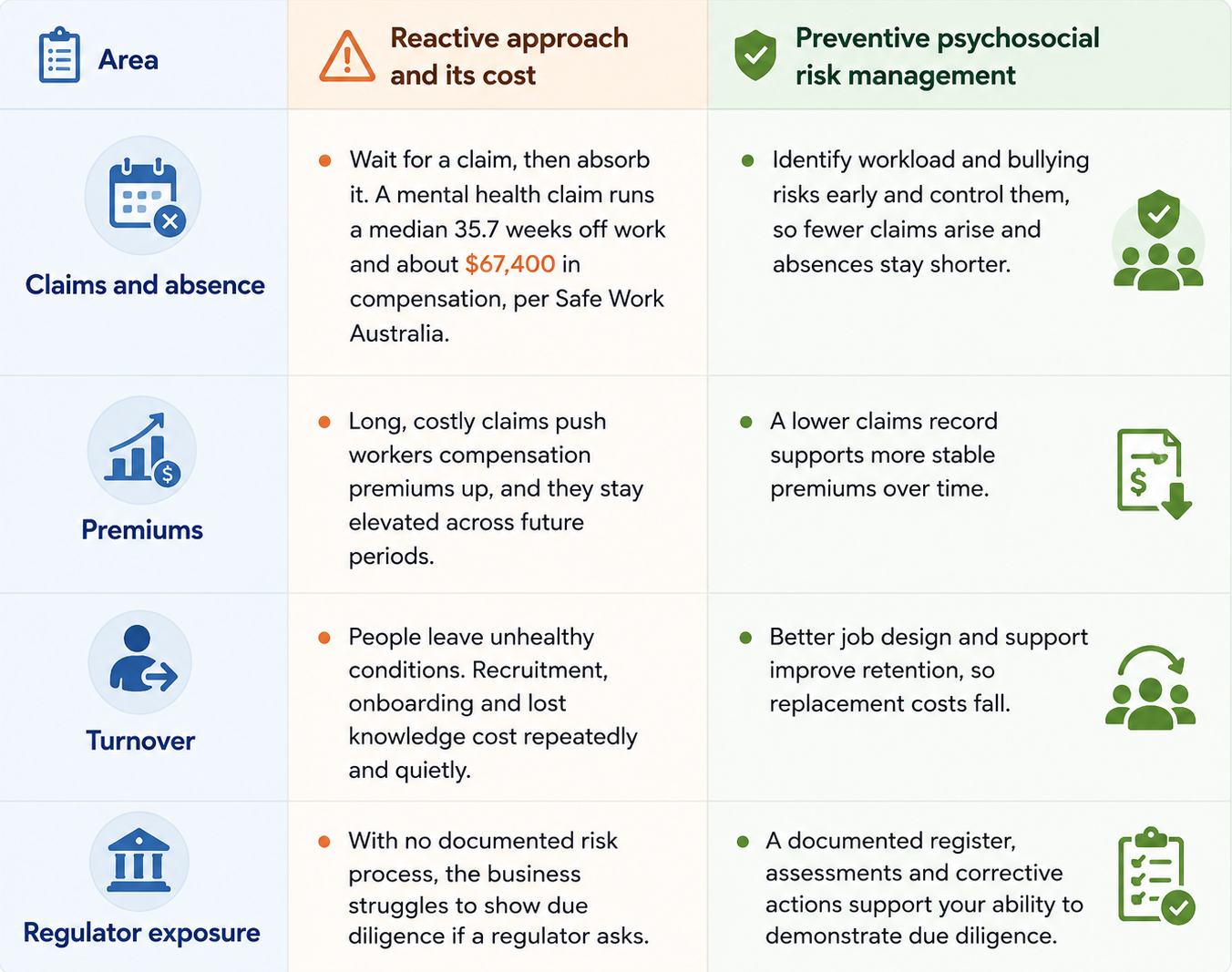
The pattern is consistent across every row. Reactive spending is larger, later and harder to control. Preventive spending is smaller, earlier and yours to direct.
What does a shift from reactive to preventive look like in practice?
Consider an Australian business that did the well-meaning things. It offered an Employee Assistance Programme, ran awareness sessions and reminded people to look after themselves.
The problem was that none of it touched the actual driver, a team running months of unsustainable workload with little control over how the work landed.
The consequence arrived as a serious psychological injury claim. The person was away for many months. The team, already stretched, absorbed the gap, and two more people started looking for the door. The awareness posters had not moved the risk, because the risk lived in the workload structure, not in individual coping.
The solution was to stop treating this as a wellbeing gap and start treating it as a risk to be managed at the source. The business built a psychosocial risk register, assessed workload and support team by team, and began capturing incidents and near misses so patterns showed up early rather than after a claim. This is where structured capture earns its place. Recording concerns consistently, and tracking each one through to a corrective action, is what turns scattered complaints into a signal you can act on. Sentrient's incident reporting software supports exactly this part of the work, giving each report a clear trail from raised to resolved.
The proof showed up over the following periods. Workload was rebalanced where the register flagged it. Bullying concerns were addressed early instead of escalating. Absences shortened, the team steadied, and the business could finally show the documented process a regulator would look for. Software did not do this on its own. Leaders made the calls and changed the work. The system gave them the visibility to make those calls in time.
Where do EAP and wellbeing perks actually fit?
They fit as support, not as controls. An EAP helps a person who is already struggling, and that matters. A wellbeing day is a kind gesture. Neither one fixes an unhealthy workload structure, and neither one lowers a hazard at the source. Prevention is about changing the work, not only supporting the worker after the work has harmed them. Keep the perks. Do not mistake them for risk management.
How does Sentrient support psychosocial risk management?
Sentrient is a Melbourne-based, Australian built and owned compliance platform used by more than 1,000 organisations across Australia and New Zealand. The Risk Management System includes a psychosocial risk register, structured assessments, incident and corrective-action tracking, and audit-ready reporting.
To be honest about scope, software does not fix root causes and does not replace leadership. It cannot rebalance a workload or repair a culture on its own. What it does is give you the register, the assessments and the record, so the people who can make those changes can see the risk early and show the work later. That supports a preventive approach. It does not replace one, and it never guarantees compliance.
For the full lifecycle view of how this works alongside physical hazards, the original article on psychosocial risk management sets out the complete picture.
Conclusion
Reactive psychosocial risk management is the most expensive way to run it, and the cost lands on people first. A median 35.7 weeks away from work is a long time out of someone's life, and the financial and legal costs follow behind. Prevention at the source costs less on every measure, in harm, in absence and in premiums. The move is not complicated to describe. Treat psychological risk the way you already treat physical risk, and put a real process behind it.
If you want to see how a structured psychosocial risk process fits your business, book a free demo and we will walk you through the register, assessments and reporting, and where a psychosocial risk assessment checklist would help your team start.
Frequently Asked Questions
1. Is psychosocial risk management a legal requirement in Australia?
Managing psychosocial risks is a work health and safety obligation. The model WHS Regulations were amended in June 2022 to require it, according to Safe Work Australia. This is general information, not legal advice, so confirm how the obligation applies to your business with a qualified professional.
2. What are the most common causes of mental health claims?
According to Safe Work Australia, harassment and workplace bullying cause 33.2 per cent of mental health claims, and work pressure causes 24.2 per cent. Both are structural workplace factors rather than individual failings, which is why controlling them at the source is far more effective than reacting later.
3. How much does a mental health claim cost?
Safe Work Australia reports a median of about $67,400 in compensation per mental health claim, with a median 35.7 weeks off work. Mental health conditions are roughly 12 per cent of serious claims but a larger share of total cost, because each claim tends to run long and run expensive.
4. Does an EAP count as psychosocial risk management?
An Employee Assistance Programme supports people who are already struggling, which is valuable, but it is not a control. It does not lower a hazard such as excessive workload at the source. Prevention means changing the work itself, so treat an EAP as support alongside a proper risk process.
5. Can software fix psychosocial risks on its own?
No. Software supports the process by holding the risk register, structured assessments and incident records, so risks surface early and the work is documented. It does not fix root causes or replace leadership. People rebalance workloads and repair cultures. The system gives them the visibility to act in time.