



Quick answer: Psychosocial hazards at work are aspects of work design, management and social conditions that can cause psychological harm. They are now regulated work health and safety hazards across Australia. The cost of leaving them unmanaged shows up directly in claims, absence and insurance premiums. Safe Work Australia data shows mental health claims run about five times longer and cost about four times more than a typical serious claim. It is far cheaper to change the work at the source than to carry a psychological injury claim.
If you run the numbers the way a CFO does, the question is simple. What does it cost when a psychosocial hazard at work goes unmanaged, and what does it cost to fix it before it becomes a claim? That is not only a financial question. Behind every psychological injury claim is a person who was harmed by how the work was set up. So we will treat the number and the human side with equal care.
Here is the controlling message. The cost of unmanaged psychosocial hazards at work now shows up directly in claims, absence and premiums. Changing the work at the source is the cheaper and the more responsible path. This is general information, not legal advice.
What are psychosocial hazards at work?
Psychosocial hazards at work are features of how work is designed, managed and organised that can cause psychological harm. Think high job demands with low control, poor support, low role clarity, bullying, and exposure to distressing material. They sit in the work itself, not in the worker.
This matters for the fix. If the hazard sits in the work, then the control sits in the work too. You manage the roster, the workload, the reporting lines and the support, rather than asking the person to cope harder. The message across the Australian regulators is consistent. Manage the work, not just the worker.
Safe Work Australia amended the model work health and safety regulations from 2022 to name psychosocial hazards directly. That change put a clear duty on employers to identify these hazards, control them at the source where reasonably practicable, and keep evidence that they did. Source: Safe Work Australia.
Why is the regulator paying attention now?
Because the claims data moved. Regulatory attention followed the numbers, and the numbers are hard to ignore.
Safe Work Australia data for 2022 to 2023 shows mental health conditions made up 12 per cent of serious workers compensation claims. Those claims carried a median of 35.7 weeks lost, against 7.4 weeks for all serious claims. The median compensation paid was $67,400, against $16,300 for all serious claims. That is roughly five times the time off and four times the cost of a typical serious claim. Source: Safe Work Australia.
The trend is the sharpest part. Serious mental health claims rose 161 per cent over a decade, the largest rise of any injury group. Source: Safe Work Australia. Psychological injury has become the highest-cost claim category, and that is what pulled it to the top of the regulatory agenda.
The states are moving in step. Victoria's Occupational Health and Safety (Psychological Health) Regulations commenced on 1 December 2025, which makes psychological health a named priority for Victorian employers. Source: WorkSafe Victoria.
What does an unmanaged hazard actually cost?
Consider a 200-person Australian organisation carrying an unmanaged workload hazard. A team has been short-staffed for months. Demands are high, control is low, and no one has logged it as a risk.
The problem is the work design. The consequence arrives as a psychological injury claim. Then the real costs stack up. There is the claim itself. There is an extended absence, and on the Safe Work Australia medians a mental health absence runs far longer than a typical one. There is backfill to cover the role, often at a premium. There is the effect on the workers compensation premium, which can carry forward for years. There is the quieter cost of turnover as others in the same team start to leave.
Taken together, for an organisation of this size a single psychological injury claim is routinely a six-figure event once absence, backfill and premium effects are counted. Treat that as a general illustration rather than a precise figure, because the exact number depends on your scheme, your industry and your claims history. The direction of travel is clear enough.
Now compare the cost of fixing the same hazard at the source. Adjusting the workload, adding support and clarifying the role costs a fraction of carrying the claim. That is the trade the table below sets out.
Cost comparison: leaving hazards unmanaged versus managing them at the source
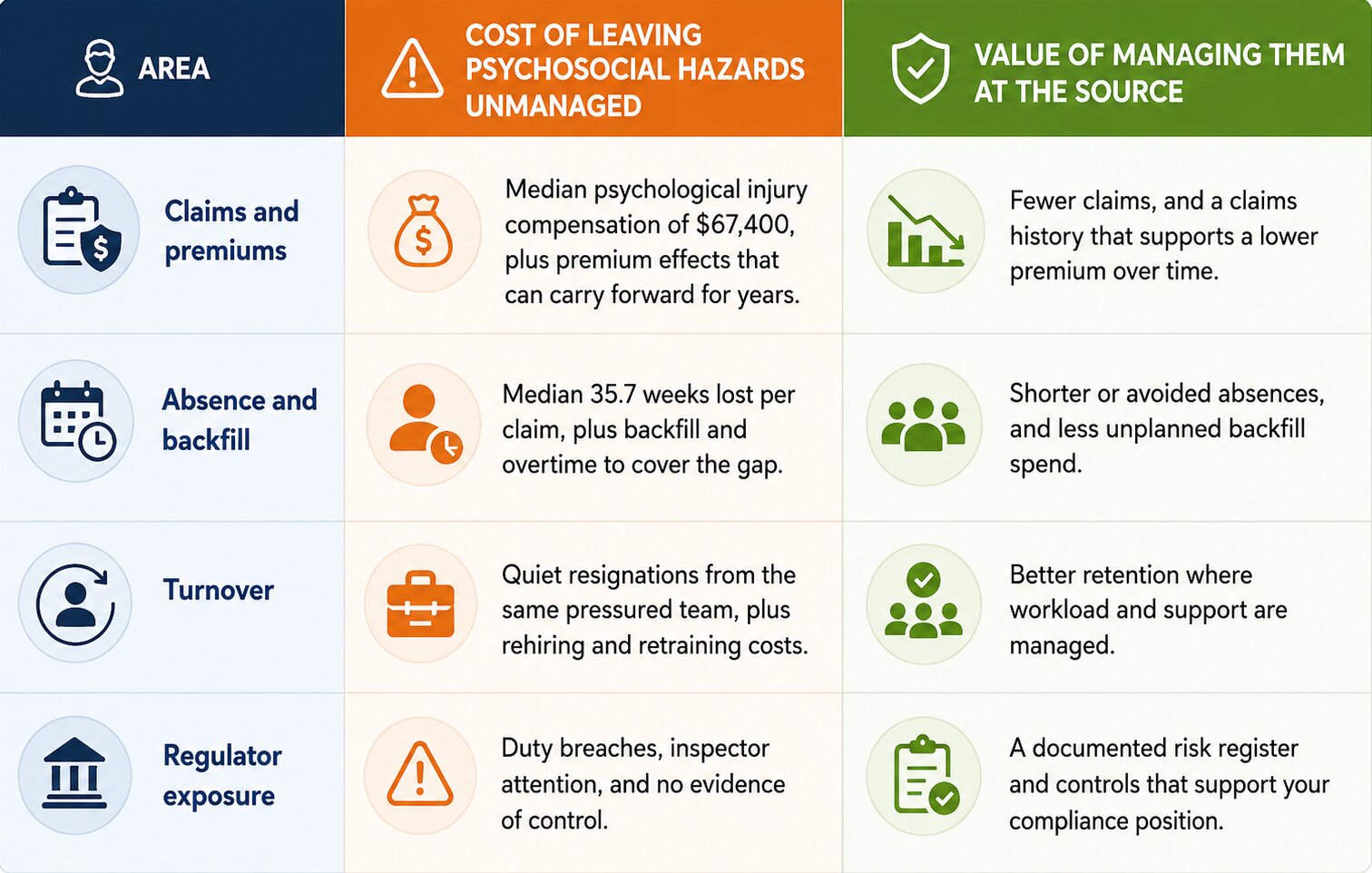
The pattern is consistent across every row. Managing the hazard early is cheaper, and it protects people before harm occurs.
How do you fix a psychosocial hazard at the source?
You work through a simple loop. Identify the hazard. Assess the risk. Control it at the source. Review whether the control worked. Then keep the evidence.
A practical starting sequence looks like this.
- Identify hazards through consultation, survey data, incident reports and turnover patterns.
- Assess which hazards carry the highest risk of psychological harm.
- Control at the source by changing workload, rostering, role clarity, support and reporting lines.
- Record each hazard, its control and a review date in a risk register.
- Review after a set period, and update the control if the risk has not dropped.
The evidence layer is where many organisations fall short. You can do the right thing and still be exposed if you cannot show it. A regulator wants to see that you identified the hazard, acted on it, and reviewed it.
This is where a system helps. Sentrient's Risk Management System supports this loop by holding the risk register, the review dates and the record of controls in one place. It helps you show your work, which supports your compliance position without ever guaranteeing an outcome. For the full plain-English background, see Sentrient's guide to psychosocial hazards at work.
Where should a busy employer start this week?
Start where the risk and the cost are highest. Look at the teams with the longest hours, the least control, and the highest turnover. That is usually where an unmanaged hazard is already forming.
Then do three things. Log what you find in a risk register with review dates. Consult the affected team, because they see the hazard before you do. Put one concrete control in place and diarise a date to check whether it worked.
None of this needs to be heavy. It needs to be recorded, reviewed and honest. That is what turns good intent into an evidence trail that supports you if a claim or an inspector ever arrives.
Sentrient is Melbourne-based, Australian built and owned, and trusted by more than 1,000 Australian organisations. It holds the evidence layer that psychosocial risk work depends on, including policies with acknowledgement, training, incident and hazard reporting, and risk registers with review dates. Most customers are operational within about a week, so the gap between deciding to act and having a record is short.
The takeaway is the one we opened with. The cost of unmanaged psychosocial hazards at work now lands in your claims, your absence and your premiums. Fixing the work at the source is cheaper, and it protects the people doing the work. Manage the work, not just the worker.
Want a simple place to begin? Book a free demo to see how a risk register and the evidence layer come together, or use it as the prompt to build your own psychosocial risk checklist. Either way, the cheaper move is to act before the claim, not after it.
This article is general information, not legal advice. For advice on your specific obligations, check the current Safe Work Australia and state regulator guidance or speak to a qualified professional.
Frequently asked questions
1. What counts as a psychosocial hazard at work?
A psychosocial hazard at work is any part of work design, management or social conditions that can cause psychological harm. Common examples include high job demands with low control, poor support, low role clarity, bullying, and exposure to distressing material. The hazard sits in the work, which is where the control belongs too.
2. Are psychosocial hazards actually regulated in Australia?
Yes. Safe Work Australia amended the model work health and safety regulations from 2022 to name psychosocial hazards directly. States have followed, and Victoria's Occupational Health and Safety (Psychological Health) Regulations commenced on 1 December 2025. Employers now have a clear duty to identify, control and keep evidence.
3. How much does a psychological injury claim cost an employer?
Safe Work Australia data for 2022 to 2023 shows a median of $67,400 in compensation and 35.7 weeks lost per mental health claim, roughly four times the cost and five times the time off of a typical serious claim. Add backfill and premium effects and the real cost climbs further.
4. How do I control a psychosocial hazard at the source?
You change the work, not the worker. That means adjusting workload, rostering, role clarity, support and reporting lines, then recording the control and a review date in a risk register. Review after a set period and update the control if the risk has not dropped.
5. What evidence should we keep for psychosocial risk?
Keep records that show you identified the hazard, controlled it and reviewed it. That includes consultation notes, a risk register with review dates, incident and hazard reports, policies with acknowledgement, and training records. This evidence layer supports your compliance position if a claim or an inspector arrives.