



Quick answer: An HR compliance audit checks your people practices against Australian legal obligations, area by area, and confirms two things. First, that you comply. Second, that you can prove it. The expensive part is rarely the audit itself. It is the back-pay, penalties and weeks of rework that follow when you cannot produce the evidence. Most of that cost is avoidable.
If you run the numbers the way a CFO would, the question is simple. What does a failed HR compliance audit actually cost the business?
The honest answer is that the audit is cheap and the failure is not. In 2024-25 the Fair Work Ombudsman recovered more than $358 million for more than 249,000 underpaid workers, according to the Fair Work Ombudsman Annual Report 2024-25. That is the pool your exposure sits inside. The real cost of a weak HR compliance audit is not the audit. It is the back-pay, penalties and scramble that arrive when you cannot prove compliance, and that cost is largely avoidable.
This article is general information, not legal advice. For advice on your specific circumstances, speak to a qualified employment lawyer or adviser.
What does a failed HR compliance audit actually cost?
More than most owners expect, and in more forms than a single fine. Picture a mid-sized Australian business, roughly 120 staff, that fails a pay and records check. The trigger is ordinary. An employee queries an award classification, the query becomes a request for records, and the records do not add up.
The fallout stacks up in layers.
- Back-pay. Underpayments are calculated per employee, per pay period, often stretching back years. Across a workforce, a small hourly gap becomes a six-figure remediation.
- Penalty exposure. In 2024-25 the Fair Work Ombudsman secured a record $23.7 million in court penalties, alongside 1,220 compliance notices, according to the Fair Work Ombudsman Annual Report 2024-25. Penalties sit on top of what you owe, not instead of it.
- Rework. Reconstructing pay data, rosters and classifications for a workforce is weeks of finance and HR time pulled off everything else.
- Reputation. Named underpayment cases travel. Customers, candidates and staff all read them.
The pattern in most cases is not an employer refusing to pay. It is an employer who cannot prove what it paid, why, and against which award. The compliance may even have been fine. The evidence was not.
Why is proving compliance the part that breaks?
Because compliance is a state and proof is a system, and most businesses invest in the first and neglect the second.
You can pay correctly and still fail an audit if you cannot show the record. Under Australian rules, employee records must be kept for seven years and pay slips issued within one working day, according to the Fair Work Ombudsman. That is a documentation standard, not an opinion. When the records live in one person's inbox, an old spreadsheet and a filing cabinet, the audit becomes an archaeology project.
The same gap shows up across the other high-risk areas.
- Policies exist, but there is no record that staff read and acknowledged them.
- Training happened, but nobody can show it is current rather than expired.
- An incident was handled well, but the report was never captured in a findable place.
- Pay was correct, but the classification logic behind it was never written down.
In each case the practice was sound and the proof was missing. An audit does not reward good intentions. It rewards evidence you can produce on demand.
What does a failed audit cost versus being audit-ready?
Here is the same set of areas viewed as cost against value. This is where the avoidable part becomes obvious.
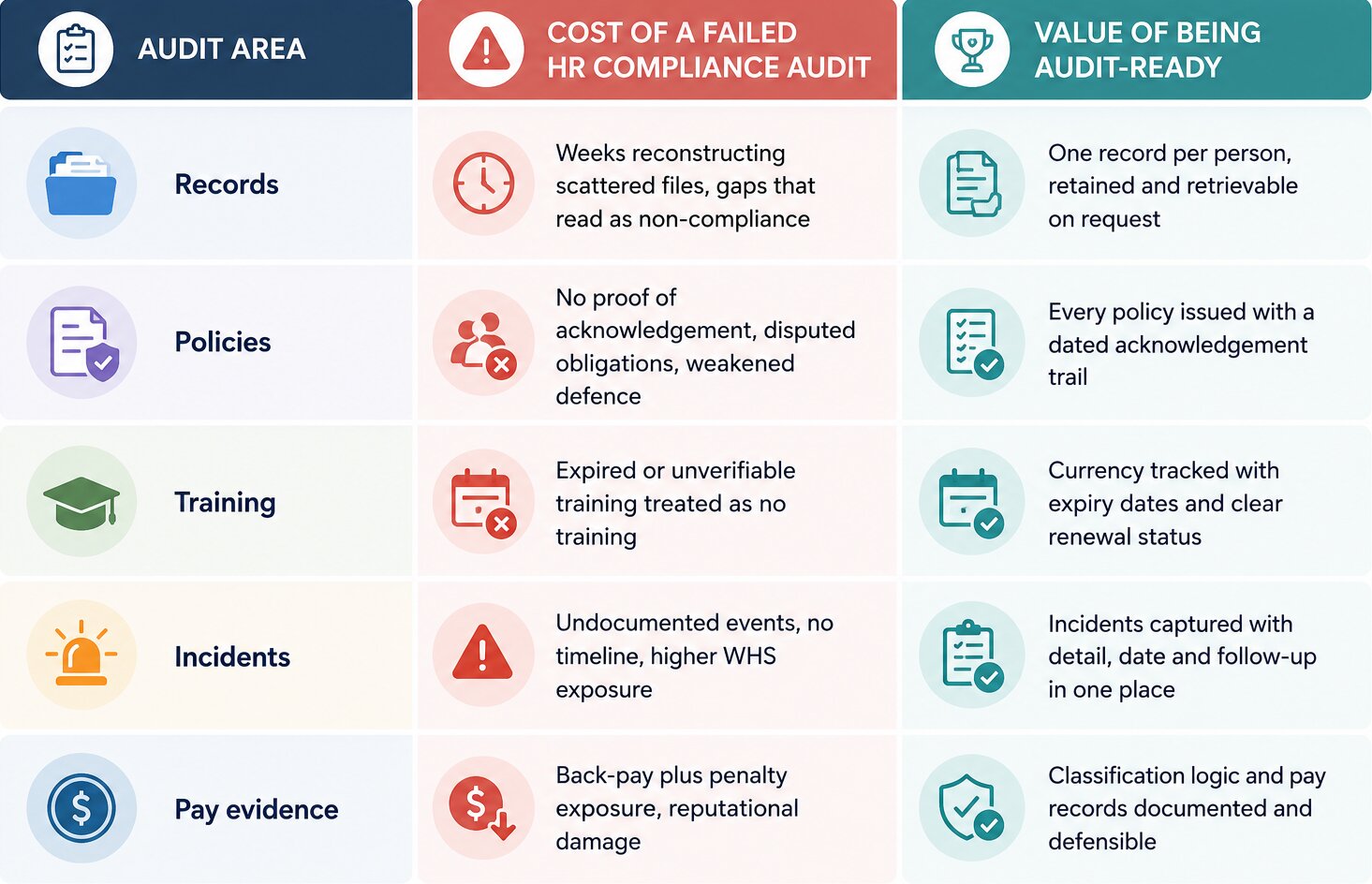
The left column is the scramble. The right column is a report you can run. The difference between them is rarely more effort. It is better structure.
How do you fix the provable side before an audit finds it?
You separate the two problems and solve the evidence one with a system. Work through it as problem, consequence, solution and proof.
-
Problem. Your compliance is probably better than your ability to prove it. The risk hides in the gap between the two.
-
Consequence. Left alone, that gap surfaces at the worst moment, during a Fair Work query or a claim, when reconstruction is slowest and exposure is highest.
-
Solution. Put your provable obligations into one place with a date and an owner. That covers policies with acknowledgement, training with expiry, incidents with a report, and records held per person.
This is the practical role of Sentrient's Records Management module. Sentrient is Melbourne-based, Australian built and owned, and trusted by more than 1,000 Australian organisations. It keeps policies with acknowledgement, tracks training with expiry dates, captures incidents, and stores records per person, so the audit turns from a scramble into a report you can run. It supports and strengthens your compliance position rather than replacing your legal obligations.
One scope note, stated plainly. Sentrient is not payroll. Pay and super are checked in your payroll system, not in Sentrient. Getting the wage and super numbers right, including the super guarantee rate that rose to 12% from 1 July 2025 according to the ATO, is a payroll job. Being able to prove the surrounding people practices is where a compliance system earns its place.
Proof. With that structure, the audit stops being an event you brace for. You run a report, per person, per obligation, with dates attached. The evidence is the point, and now the evidence exists.
Which areas should you check first?
Start where failure is most expensive and proof is weakest. For most Australian employers that order looks like this.
- Pay and wage records, because underpayment carries the largest back-pay and penalty exposure.
- Record-keeping, because the seven-year retention and one-day pay slip standards are non-negotiable.
- Policies and acknowledgement, because an unacknowledged policy is hard to rely on.
- Training currency, because expired training reads as no training.
- WHS, because employers must meet safety duties under the model WHS laws, according to Safe Work Australia, and undocumented incidents raise exposure.
Work top to bottom. Fix the compliance where it is genuinely wrong, and fix the proof everywhere else.
Conclusion
The cost of a weak HR compliance audit is not the audit. It is the back-pay, the penalties and the weeks of rework that follow when you cannot prove compliance, and almost all of that is avoidable with better structure rather than more effort. Get the pay and super numbers right in payroll. Then make every other obligation provable, with a date and an owner, before anyone asks.
That is the shift Sentrient supports. Policies with acknowledgement, training with expiry, incidents captured, records per person, and an audit that becomes a report you can run instead of a scramble you dread. For the full area-by-area method, read the original guide, How To Run An HR Compliance Audit.
Frequently asked questions
1. What is an HR compliance audit?
An HR compliance audit is a structured check of your people practices against Australian legal obligations, area by area. It confirms both that you comply and that you can prove it. The audit covers pay, records, policies, training, WHS and privacy, and it is general information, not legal advice.
2. How often should we run an HR compliance audit?
Most Australian employers run a full HR compliance audit once a year, with lighter checks each quarter. Review sooner after major changes, such as award updates, restructures, rapid hiring or new legislation. Regular, smaller checks keep evidence current and stop small gaps from becoming expensive surprises.
3. What does an HR compliance audit usually cost a business?
The audit itself is relatively cheap. The expensive part is failure. Back-pay is calculated per employee across years, and penalties sit on top. In 2024-25 the Fair Work Ombudsman recovered more than $358 million for underpaid workers, which shows the scale of avoidable exposure.
4. Can software make our next HR compliance audit easier?
Yes, on the provable side. A compliance system keeps policies with acknowledgement, tracks training expiry, captures incidents and stores records per person, so evidence is ready on request. It supports your compliance position. It does not replace payroll, legal advice or your own obligations as an employer.
5. How long do we need to keep employee records?
Under Fair Work rules, employee records must be kept for seven years, and pay slips must be issued within one working day. Missing or incomplete records can read as non-compliance even when your actual practices were sound, which is why retrievable record-keeping matters as much as the practice itself.