



Quick answer: Poor asset ownership and tracking costs far more than most budgets ever show. The real losses hide inside data breach exposure, failed audits, unrecovered equipment and rework. The fix is to make ownership explicit, so every asset has a named owner, a location and a live record. Do that, and most of the cost comes back.
Ask a finance or operations leader what a missing laptop costs, and the honest answer is usually the replacement price. That number is wrong, and it is wrong by a wide margin. Strong asset ownership and tracking is the difference between a cheap replacement and a notifiable data breach, between a clean audit and weeks of rework.
This article builds on the original Sentrient guide on asset ownership and tracking across multiple sites, and looks squarely at the money side of getting it wrong.
The pattern is consistent. Poor asset ownership and tracking is expensive in ways that never appear on a budget line. The good news is that the cost is recoverable once ownership is made explicit.
Why does poor asset ownership and tracking cost more than the replacement price?
Tracking tells you what you own. Ownership tells you who answers for each item. When the second part breaks down, the item still exists, but nobody is accountable for it. That gap is where the money leaks.
Assets carry duties, not just value. A laptop carries personal data under privacy law. Registered plant carries safety duties under work health and safety law. Every asset carries a record obligation for finance and audit. When ownership is unclear, those duties still apply. You simply find out the hard way, at the worst possible time.
The replacement price is the only cost that shows up cleanly on a ledger. The rest arrives as breach response, audit rework, insurance disputes and lost staff hours. None of those line up neatly against the asset that caused them, which is exactly why they get missed.
What happens when a mid-sized multi-site business loses track of its assets?
Picture a mid-sized Australian business with four branches. Head office runs the asset register, or thinks it does. Laptops, tablets, testing equipment and small plant move between sites as staff and jobs shift. Nobody updates the register when they move.
Over eighteen months the drift adds up. A branch closes a contract and returns gear that never gets logged back in. Two staff leave without a proper offboarding, and their devices are never recovered. A piece of registered plant is used at a second site, and the inspection record stays with the first.
On paper, nothing looks broken. The trouble is that the register no longer matches reality. When a duty is tested, the business cannot say who holds what, where it is, or whether it was maintained. That is the moment the hidden costs land all at once.
How does an unaccounted device become a notifiable data breach?
This is the sharpest version of the problem. A lost or unaccounted device holding personal information can be a notifiable data breach under the Privacy Act, according to the OAIC Notifiable Data Breaches scheme. The trigger is not the value of the hardware. It is the data on it and the fact that you can no longer account for it.
The numbers show how live this risk is. The OAIC recorded 1,205 notifiable data breaches in Australia in the 2025 calendar year, an 8 per cent rise on 2024 and an all-time high. In the January to June 2025 period, human error caused 37 per cent of notifiable data breaches, some 193 notifications, up from 29 per cent in the previous half, the OAIC reports.
A device that walks out the door during a messy offboarding is human error made physical. When you cannot prove who held it, when they held it, or what was on it, you are exposed on the exact facts a breach assessment turns on.
Safety carries the same logic. Under work health and safety law a person conducting a business or undertaking must provide and maintain safe plant, and the WHS Regulations require registered plant to be inspected before each use, with duties to register, inspect, maintain and keep records, according to Safe Work Australia. If a machine moves between sites and its inspection history does not move with it, the duty is still yours. You just cannot prove you met it.
What does managed asset ownership and tracking actually save?
Here is the cost picture side by side. The same five areas, run two ways.
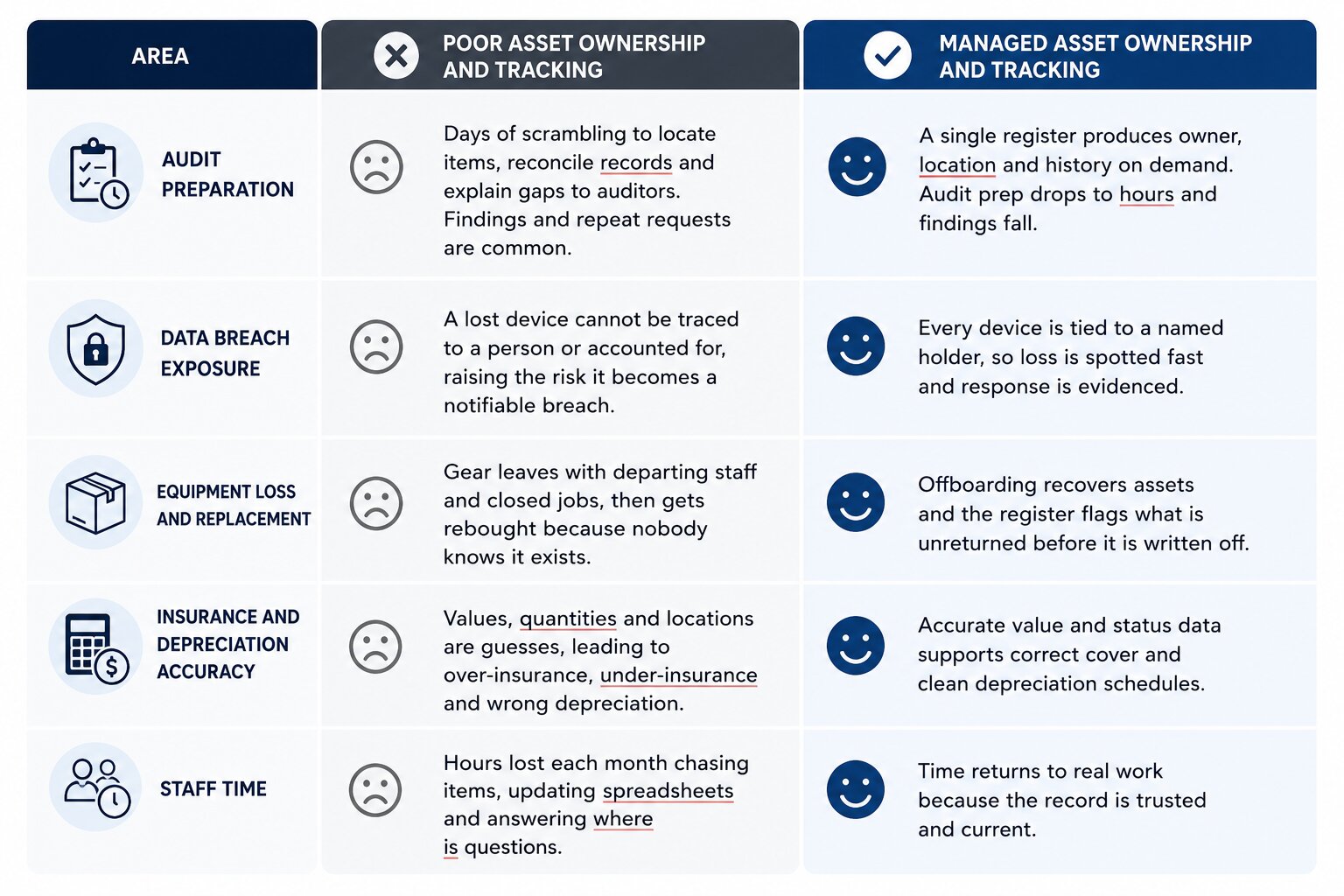 None of the right-hand column is exotic. It is what happens when every item has a unique identity, an assigned owner and a maintained location.
How do you make ownership explicit across every site?
Multi-site is where registers fail, because ownership is not maintained as items move. The fix is a single register that travels with the asset rather than the site. A complete asset register should hold the following for every item.
- Unique ID and a clear description
- Assigned owner, a named person who answers for it
- Location and site, kept current as it moves
- Status and condition
- Maintenance and inspection history
- Purchase and value details
- Handover records for every transfer
For larger multi-site operations, Enterprise Asset Management software holds every tangible asset in a centralised database across its full lifecycle, ties assets to people through onboarding and offboarding, and produces asset-by-staff reports showing who holds what. Melbourne-based and Australian built and owned, Sentrient is built for Australian and New Zealand organisations and is trusted by more than 1,000 of them.
The point is not the software on its own. It is that ownership becomes a fact the system maintains, not a memory that fades every time someone changes branch. That is what turns a list of things into an accountable register. Sentrient supports this discipline and helps teams keep it current. It does not remove the underlying legal duties, which stay with the business.
Bringing the cost back
The hidden costs of poor asset ownership and tracking are real, but they are not fixed costs. They are the price of an unclear register, and they come down when ownership becomes explicit. A named owner, a current location and a maintained history for every item is how you stay accountable when a duty is tested, and how you stop paying for the same gear twice.
Start with the money you can see. Then follow it to the money you cannot, in breach exposure, audit rework and lost time. That is the case for fixing it, and it usually pays for itself well before the next audit.
Sentrient helps Australian and New Zealand organisations bring asset ownership under control with a centralised register that ties every item to a person and a site.
Book a free demo and ask for the asset register checklist, so you can see exactly where your current register leaves you exposed.
Frequently asked questions
1. What is the difference between asset tracking and asset ownership?
Tracking records what you own and where it is. Ownership records who answers for each item. You need both. Tracking without a named owner tells you an asset exists, but not who is accountable for its safety, data or records when a duty is tested.
2. Can a lost work laptop really be a notifiable data breach?
Yes. A lost or unaccounted device holding personal information can be a notifiable data breach under the Privacy Act, according to the OAIC. The trigger is the data on the device and your inability to account for it, not the value of the hardware itself.
3. Why do asset registers fail across multiple sites?
Multi-site is where registers fail because ownership is not maintained as items move. Gear shifts between branches, staff and jobs, but the register is not updated. Over time the record stops matching reality, so nobody can say who holds what or where it sits.
4. What records should a compliant asset register hold?
A complete register holds a unique ID and description, an assigned owner, location and site, status and condition, maintenance and inspection history, purchase and value details, and handover records for every transfer. Kept current, this is what supports audits and evidences your safety and privacy duties.
5. How does software help with asset ownership and tracking?
Software supports the discipline by holding every asset in one place, tying items to people through onboarding and offboarding, and reporting who holds what. It helps teams keep the register current across sites. It supports compliance but does not remove the legal duties that stay with the business.