



Quick answer: The cost of ignoring psychosocial hazards is no longer abstract. Australian employers face rising claims, long absences and large compensation payouts when workplace mental health risks go unmanaged. Under WHS law you must identify and control these hazards. A documented, active system makes that duty far easier to meet.
Most business owners understand physical safety. Guard the machine. Mark the wet floor. Issue the hard hats. Psychosocial hazards feel less obvious, yet they now sit at the centre of Australia's workplace injury problem. High job demands, low control, poor support, bullying and exposure to traumatic content all count as real hazards under the law.
The mistake many employers make is treating mental health as a "nice to have" rather than a legal duty. That gap is expensive. Regulators across every state and territory now expect you to manage psychosocial risk the same way you manage a trip hazard or a faulty forklift. Ignore it, and the bill arrives later through claims, lost productivity and reputational damage.
This article walks through the genuine cost, the legal backdrop and the practical steps to close the gap before a regulator or a claim does it for you.
What is the real cost of ignoring psychosocial hazards?
The real cost shows up in three ways: more claims, longer absences and higher payouts. These are not projections. They come straight from national data.
Safe Work Australia reports that serious mental health claims rose 14.7% in a single year, from 15,300 to 17,600 in 2023–24 (Safe Work Australia, Key WHS Statistics 2025). Mental health conditions now make up around 12% of all serious claims, the highest proportion ever recorded. Zoom out further and the trend is sharper still. Serious psychological claims have grown roughly 161% over the past decade, the largest growth of any injury category.
The cost is not only the volume of claims. It is the length and weight of each one.
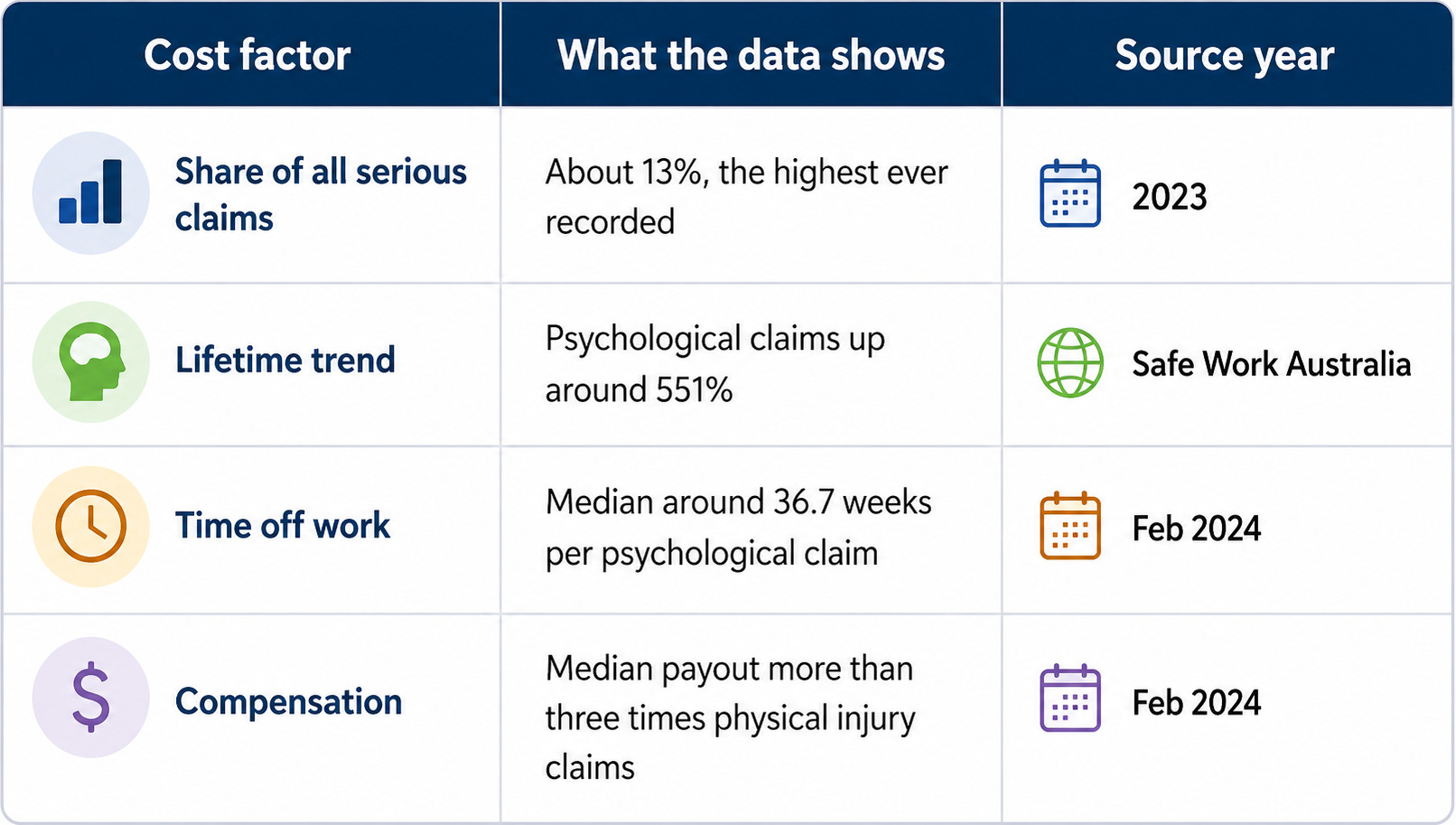 A worker with a psychological injury is off work for a median of around 35.7 weeks (Safe Work Australia, February 2024). That is more than eight months. The median compensation paid for mental health conditions runs more than three times that of physical injuries. Behind every figure sits backfill costs, lost knowledge, strained teams and a slower return to full capacity.
Why is ignoring psychosocial hazards now a legal risk?
It is a legal risk because the law changed and enforcement followed. WHS regulations across Australia now place an explicit duty on employers to identify psychosocial hazards and control them so far as is reasonably practicable.
This is not guidance you can shelve. It mirrors the duty you already hold for physical safety. Regulators expect a clear process: spot the hazards, assess the risk, put controls in place and review them. A single policy document sitting in a drawer does not meet that standard. Inspectors look for a living system that shows what you found, what you did and how you check it still works.
The shift matters because it removes the old excuse. Employers can no longer say mental health risk was unforeseeable. The hazards are named in the regulations and codes of practice. If you have not looked, that itself can be a failure of due diligence.
How do small and mid-sized employers get caught out?
They get caught out by assuming the rules only apply to large or high-risk workplaces. They do not. Every Australian employer with workers carries the duty.
Common traps include:
- Writing a policy but never training managers to spot or respond to hazards.
- Running no way for staff to safely raise concerns, so risks stay hidden.
- Treating one wellbeing webinar as a complete control.
- Keeping no records, so there is nothing to show a regulator after an incident.
- Reacting only after a claim lands, when the cost is already locked in.
Consider a Melbourne professional services firm of 60 staff. Workloads climbed through a busy period. Two senior people quietly burned out and lodged claims. The firm had a values statement on the wall but no hazard process, no staff survey and no manager training. The claims were accepted, both people were off work for months, and the business had no evidence it had taken reasonable steps. The cost of ignoring psychosocial hazards became very concrete, very fast.
What does a compliant approach actually look like?
A compliant approach is a cycle, not a document. You identify hazards, assess the risk, apply controls, and review whether they are working. Then you do it again.
In practice that means:
- Consult your workers. Use surveys and conversations to surface real hazards like excessive demands or poor support.
- Assess the risk. Decide which hazards are most serious and who is exposed.
- Apply controls. Adjust workloads, clarify roles, train managers, and set clear reporting paths.
- Record everything. Keep your assessments, actions and review dates in one place.
- Review regularly. Check controls after changes such as restructures or workload spikes.
The thread running through all of this is visibility. You cannot control a hazard you cannot see, and you cannot prove diligence without records. This is exactly where a connected platform helps.
A workplace compliance system brings courses, policies, surveys and records into one place, giving you whole-of-business visibility instead of scattered spreadsheets and inboxes. You can run a psychological safety check through online survey software, assign a Psychological Health and Safety training course to managers, and keep a clean record of who did what and when. It does not guarantee compliance, but it makes meeting your duty far more manageable.
How do you turn this into action this quarter?
Start with what you can see and measure. You do not need a perfect system on day one. You need to begin the cycle and document it.
Run a short, confidential survey to find your real hazards. Train your managers so they can respond instead of escalating. Write your actions down and set a review date. Sentrient is Australian owned and operated, based in Melbourne, and supports more than 1,000 Australian organisations and over 150,000 staff to manage compliance in one connected place. That scale exists because the duty is now universal and the cost of inaction keeps climbing.
The numbers are clear. Claims are up, absences are long, and payouts are heavy. The good news is that every one of those costs is reduced by the same thing: a documented, active approach to managing psychosocial risk.
Ready to close the gap? Book a demo and see how Sentrient brings your psychosocial risk controls, training and records together so you can show you have taken reasonable steps.
Frequently Asked Questions (FAQs)
1. What does "the cost of ignoring psychosocial hazards" really mean?
It means the financial and human toll of unmanaged workplace mental health risk. In Australia that shows up as rising claims, long absences of around 35.7 weeks, and median payouts more than three times those of physical injuries, alongside hidden costs like backfill and lost productivity.
2. Are psychosocial hazards a legal duty for all Australian employers?
Yes. WHS regulations across Australia require every employer to identify psychosocial hazards and control them so far as is reasonably practicable. The duty is not limited to large or high-risk workplaces. It applies wherever you have workers, regardless of business size or industry.
3. What counts as a psychosocial hazard at work?
Psychosocial hazards include high job demands, low job control, poor support, role conflict, bullying, harassment, and exposure to traumatic content. They are workplace factors that can harm mental health. Like physical hazards, they must be identified, assessed and controlled under your WHS obligations.
4. How much have psychological injury claims grown in Australia?
Safe Work Australia reports serious mental health claims rose 14.7% in 2023–24, from 15,300 to 17,600. Over the past decade, psychological claims grew around 161%, the largest growth of any injury category. They now make up roughly 12% of all serious claims, the highest share recorded.
5. Can software help manage psychosocial risk?
It can help significantly. A connected compliance system brings surveys, training, policies and records into one place, giving whole-of-business visibility. That makes it easier to identify hazards, apply controls and prove you took reasonable steps. It supports your duty but does not guarantee compliance on its own.