



Quick answer: The risks of choosing the wrong asset management software include untracked and lost assets, missed maintenance, unplanned downtime, and registers you cannot produce at audit. Each one carries real cost and WHS exposure. The fix is to buy for compliance first and consolidate every asset record in one place.
Most asset problems do not announce themselves. They build quietly. A laptop leaves with a departing employee and never comes back. A service due date slips past unnoticed. A safety inspection record sits in someone's inbox instead of a register. On any single day, none of this looks urgent. Then an auditor asks for a complete asset register and the gaps become very expensive very fast.
That is why the software you pick matters more than the feature list suggests. Choosing the wrong asset management software is not a neutral decision. It shapes whether your organisation can prove maintenance, track ownership, and stand behind its records when someone in authority asks. Get it wrong and you inherit the exact risks you were trying to remove.
This article walks through those risks, the consequences that follow, and the practical path Australian HR, compliance, operations, and finance leaders can take to fix them.
What are the real risks of choosing the wrong asset management software?
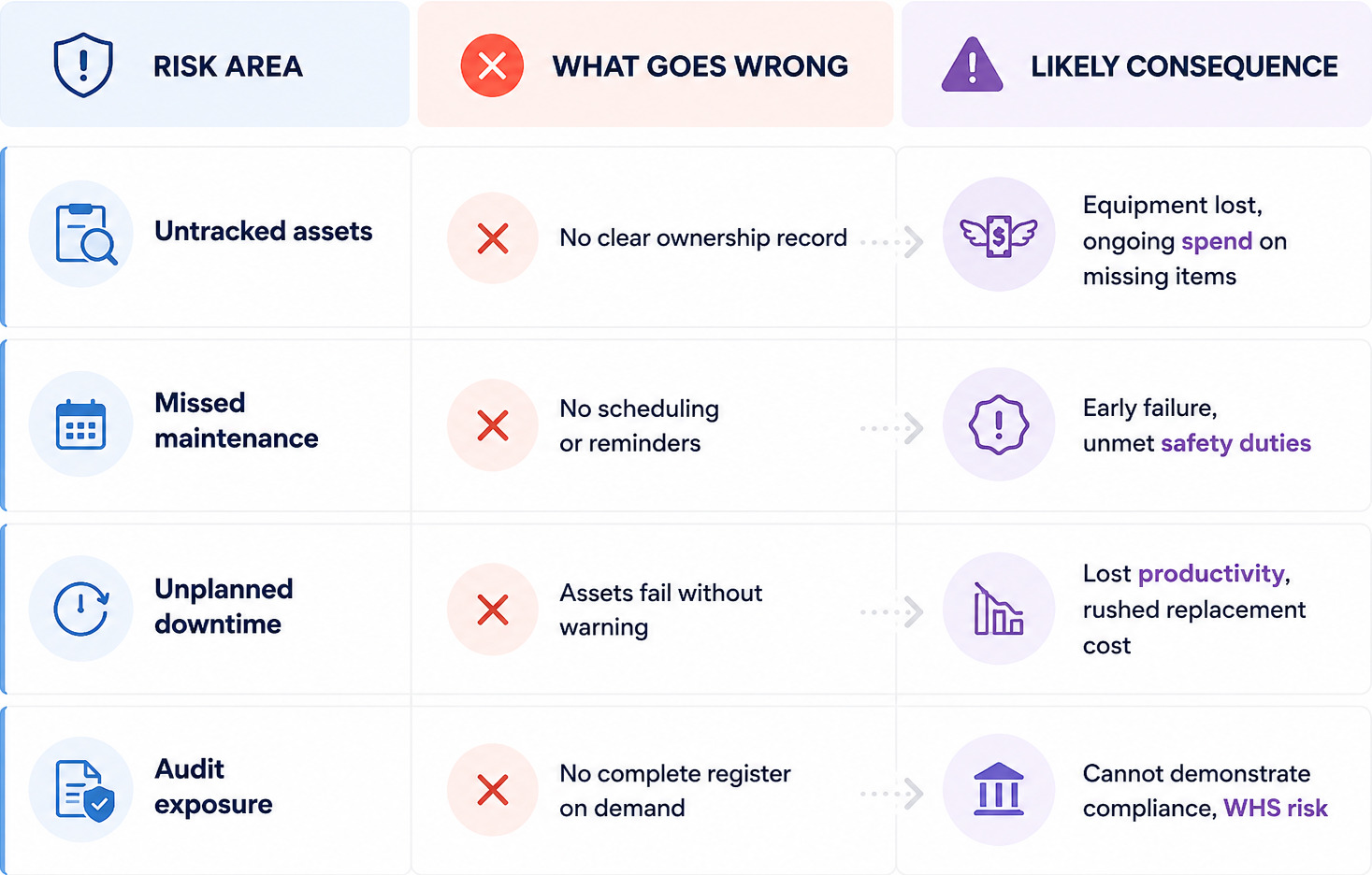
The risks of choosing the wrong asset management software fall into four connected categories. Miss one and the others usually follow.
- Untracked and lost assets. When ownership is unclear, equipment walks out the door and is never recovered. You keep paying for things you no longer hold.
- Missed maintenance. Software that does not schedule and remind lets service dates lapse. Assets fail sooner and safety obligations go unmet.
- Unplanned downtime. A failed asset stops work. Productivity drops while you scramble for a fix or a replacement.
- Audit and WHS exposure. If you cannot produce a current, accurate register, you cannot show you met your obligations. That is the risk that turns a paperwork gap into a compliance problem.
The wrong tool does not cause these on its own. It simply fails to prevent them, which in practice is the same outcome.
How much does the wrong choice actually cost?
Answer first: more than the licence fee you were trying to save. The largest hidden cost sits in downtime and lost productivity when assets fail without warning.
The scale is worth understanding. According to Siemens in The True Cost of Downtime 2024 (global), unplanned downtime costs the world's 500 largest companies an estimated US$1.4 to 1.5 trillion a year, roughly 11 per cent of turnover. The same report finds a single hour of unplanned downtime can cost a large facility over US$260,000, and that the average large facility loses around 800 hours to downtime every year.
Those figures are global and describe large enterprises. Most Australian organisations operate at a smaller scale. But the principle holds at any size. When an asset you depend on stops working and you had no maintenance schedule or replacement plan, work stops with it. The cost lands as lost hours, rushed procurement, and missed deadlines rather than a line item you can see coming.
Why does compliance need to come first in the decision?
Because compliance is the risk with the sharpest edge. In Australia, work health and safety duties require you to maintain plant and equipment and to keep records that show you did. When an auditor or a regulator asks for evidence, a spreadsheet that three people edit and nobody owns is not a strong answer.
Buying for compliance first flips the usual order. Instead of starting with the flashiest dashboard, you start with a plain question. Can this system produce a complete, current asset register, with maintenance history and assignment details, at a moment's notice? If the answer is no, the rest of the feature list does not matter.
This is the single most common error we see, and it connects directly to the wider pattern of asset management mistakes that quietly erode compliance over time. For a fuller framework on evaluating tools against these obligations, the Sentrient asset management software buyers guide sets out what to check before you commit.
What does the path to fixing it look like?
Answer first: consolidate every asset record into one system, then buy against your compliance obligations rather than against a demo reel.
Here is a practical sequence.
- Find every record. List where asset information currently lives. Spreadsheets, shared drives, email threads, that one folder on someone's desktop.
- Consolidate into a single register. One source of truth removes the gaps between systems where assets get lost.
- Attach the compliance detail. Assignment, maintenance schedule, service history, and inspection records belong with each asset, not somewhere else.
- Set reminders. Automated scheduling means maintenance and inspections happen on time instead of when someone remembers.
- Test the audit question. Ask the system to produce a full register today. If it cannot, you have found your requirement.
Consider a mid-sized Melbourne services business managing several hundred devices and tools across three sites. Before consolidation, each site kept its own spreadsheet. Nobody could say with confidence how many laptops the business owned. After moving to a single register with assignment and maintenance records attached, the finance team could reconcile assets in minutes and the operations lead could evidence servicing on request. The change was not dramatic technology. It was one accurate list that everyone trusted.
Keep every asset record in one place
A dedicated system removes the guesswork. Sentrient's Asset Management System keeps every asset, its assignment, its maintenance schedule, and its compliance record together in one place. That makes it easier to track ownership, stay on top of servicing, and produce the register you need when an audit lands. It supports your compliance work rather than leaving you to reassemble records under pressure.
How do you avoid making the wrong choice again?
Answer first: judge software on whether it reduces the four core risks, not on how it looks in a five-minute demo.
Use a short test. Does the tool give each asset a clear owner? Does it schedule and remind on maintenance? Does it hold service and inspection history? Can it produce a complete register on demand? A yes to all four means the tool addresses the risks that cost you money and expose you at audit. A no anywhere is a gap you will pay for later.
The goal is not the most features. It is the fewest gaps.
Conclusion
The risks of choosing the wrong asset management software are real, connected, and avoidable. Untracked assets, missed maintenance, unplanned downtime, and audit exposure all stem from the same root cause, which is scattered records and no single system that owns them. Fix the root cause and the risks shrink together.
Sentrient is Australian owned and operated, based in Melbourne, and supports more than 1,000 Australian organisations and over 150,000 staff. If you want to see how a single, compliance-ready asset register works in practice, book a demo and we will walk you through it.
Frequently Asked Questions (FAQs)
1. What is the biggest risk of choosing the wrong asset management software?
The biggest risk is audit exposure. If the system cannot produce a complete, current asset register with maintenance and assignment records on demand, you cannot demonstrate you met your obligations. That single gap turns everyday record-keeping into a compliance and WHS problem.
2. How does the wrong software lead to lost assets?
When software does not assign clear ownership to each asset, equipment moves without a trail. Items leave with staff or between sites and never return. You keep paying for assets you no longer hold, and nobody can say with confidence what the organisation actually owns.
3. Why should compliance drive the software decision?
Because compliance carries the sharpest consequences. Australian WHS duties require you to maintain equipment and keep records that prove it. If the tool cannot evidence maintenance and produce a register quickly, its other features do not matter. Buying for compliance first removes the most expensive risk.
4. Can consolidating asset records really reduce cost?
Yes. Scattered records create the gaps where assets get lost and maintenance slips. Consolidating everything into one register removes those gaps, so servicing happens on time, ownership stays clear, and you avoid the downtime and lost-asset costs that scattered systems quietly generate over months.
5. What should I check before buying asset management software?
Check four things. Does each asset have a clear owner? Does the tool schedule and remind on maintenance? Does it hold service and inspection history? Can it produce a full register on demand? Four yeses means the tool addresses the risks that cost money and expose you at audit.