



Quick answer: The risks of poor policy management in regulated industries include failed audits, rising penalties, unenforceable disciplinary action and reputational damage. Outdated, scattered and unacknowledged policies leave gaps regulators can act on. A centralised, version-controlled system with a sign-off trail helps close those gaps and keeps evidence audit-ready.
Policies feel like paperwork until an auditor asks for proof. In regulated sectors such as NDIS, aged care, health, education and financial services, that request arrives without warning. The regulator does not want to hear that a policy exists somewhere. They want the current version, the date it was approved and a record showing which staff read and acknowledged it.
Most organisations discover their exposure at exactly the wrong moment. A policy sits three versions out of date on a shared drive. Two teams work from conflicting copies. Nobody can produce evidence that frontline staff ever signed off. On paper the organisation looks compliant. Under scrutiny, the gaps are obvious and expensive.
The uncomfortable truth is that policy management drifts quietly. No single failure announces itself. Documents multiply, ownership blurs, and reminders to re-sign fall down the priority list. By the time a complaint, incident or scheduled audit forces the question, the organisation is reconstructing history rather than retrieving records. That reconstruction is where credibility is lost.
This article breaks down the specific risks of poor policy management in regulated industries, what they cost when they surface, and the practical path to an audit-ready system.
What are the real risks of poor policy management in regulated industries?
The core risk is simple. You cannot prove control over documents that govern how your people work. That single gap cascades into several distinct failures.
- Audit failure. Regulators expect current, accessible and acknowledged policies. Missing evidence is treated as a control breakdown, not an administrative slip.
- Unenforceable action. Disciplinary decisions rely on staff having understood the relevant policy. No acknowledgement record weakens the case.
- Inconsistent practice. Conflicting versions across teams mean people follow different rules for the same task.
- Reputational damage. Enforcement outcomes are often published. Clients, families and funders notice.
- Rising financial exposure. Sector penalties are climbing sharply, and weak policy evidence makes providers easier targets.
Each risk feeds the next. Scattered documents create inconsistent practice. Inconsistent practice creates incidents. Incidents trigger scrutiny that exposes the missing acknowledgement trail.
Boards feel this too. Directors in regulated sectors carry oversight duties, and "we assumed staff had read it" is not a defence a board wants to rely on. When the acknowledgement record is missing, the failure travels upward. It stops being an HR administration issue and becomes a governance question the board must answer.
How does poor policy management lead to compliance penalties?
It rarely causes a penalty on its own. It removes your defence when something else goes wrong. When an incident occurs, the regulator asks whether the provider had adequate systems in place. A current policy that every relevant staff member has acknowledged is direct evidence you did. A missing or unread policy is evidence you did not.
The financial stakes are rising fast. Under the NDIS Amendment (Integrity and Safeguarding) Bill 2025, the maximum NDIS Code of Conduct fine where a failure leads to death or serious injury is set to increase from $400,000 to $16.5 million, according to MinterEllison. Enforcement is already active. The NDIS Quality and Safeguards Commission reports that the Federal Court ordered provider Aurora to pay a $2.2 million penalty for breaches of registration conditions and the NDIS Code of Conduct.
Against numbers like these, the cost of unacknowledged policies stops being abstract. The gap is common. A Pinsent Masons Out-Law survey found that 50% of organisations make no effort to check that employees read policies, and only 15% record the signing of all policies.
Which policy management failures cause the most exposure?
The most damaging failures are the ones that are easy to overlook day to day. The table below maps the common failure to what it costs when an auditor arrives.
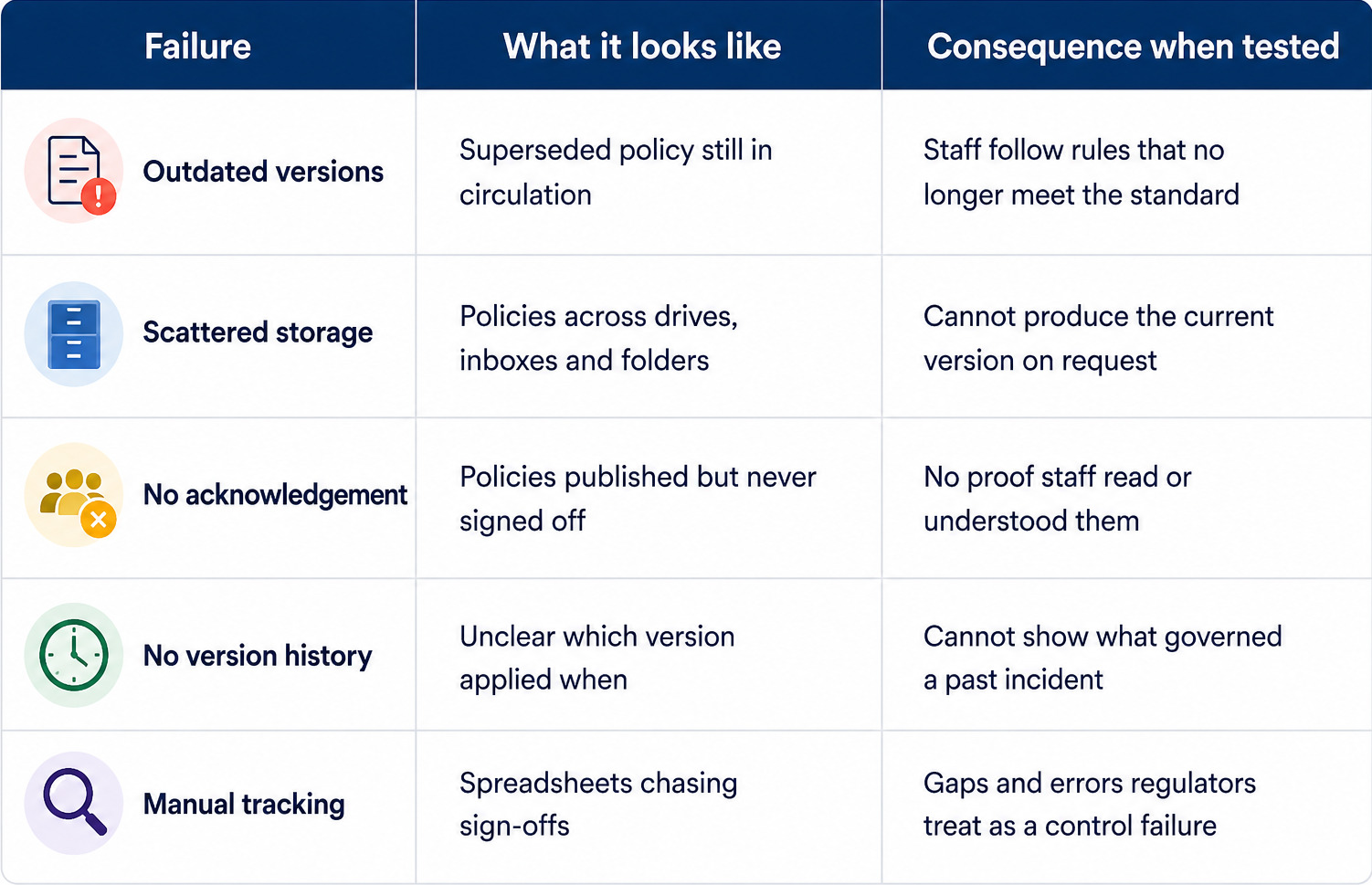 The pattern is consistent. The failures are quiet in normal operations and loud the moment evidence is required.
Manual tracking deserves special attention because so many teams still rely on it. A spreadsheet of names and dates feels like control until you test it. People join and leave. Roles change. A policy updates and the old sign-offs no longer count. Keeping that spreadsheet accurate across dozens of policies and hundreds of staff is a full-time job nobody actually owns. Regulators know this, which is why manual evidence invites closer questions rather than fewer.
How do you reduce the risks of poor policy management?
You move from ad hoc documents to a managed system built on one principle. There is a single source of truth, and every interaction with it is recorded.
- Centralise every policy. One controlled library. No competing copies on personal drives.
- Enforce version control. One current version. A visible history of what changed and when.
- Track acknowledgement. Assign policies to the right people and capture a dated sign-off from each.
- Automate the reminders. Chase outstanding acknowledgements automatically rather than by hand.
- Keep an audit trail. Every version and every sign-off timestamped and exportable on request.
This is the practical shift behind sound workplace policy management regulated industries depend on. The goal is not more documents. It is provable control over the ones you have.
Consider a mid-sized NDIS provider running services across several Victorian sites. Before centralising, each site manager kept a local policy folder. During an audit, the provider could not confirm which incident-reporting version applied at one site six months earlier. After moving to a single controlled library with tracked sign-offs, the same provider could export the exact version and the full acknowledgement list for any date in minutes.
The change was not only technical. It shifted who did the chasing. Instead of a compliance officer emailing site managers and updating a spreadsheet by hand, the system assigned each policy, tracked every response and flagged the few staff still outstanding. The officer spent their time on genuine risk rather than on administrative catch-up. That is the quiet payoff of a managed system. It removes the manual work that fails first under pressure.
Turn scattered policies into a single source of truth. Sentrient's policy management and acknowledgement software gives you one controlled library with built-in version control and a complete sign-off trail. Assign policies to the right people, capture dated acknowledgements automatically, and export audit-ready evidence when a regulator asks. It supports your compliance obligations and makes proving them far easier.
What does an audit-ready policy system look like in practice?
It looks unremarkable, which is the point. When a regulator asks for a policy, you produce the current version, its approval date and the acknowledgement record in a few clicks. No frantic search across drives. No hoping a spreadsheet is up to date.
A workable setup shares a handful of traits.
- Every policy lives in one place with clear ownership.
- Each version is dated and traceable.
- Acknowledgements are captured, timestamped and reportable.
- Reminders run automatically until sign-off is complete.
- Reports export on demand for auditors and boards.
Sentrient supports more than 1,000 Australian organisations and over 150,000 staff, across councils, NDIS providers, schools and not-for-profits. It is Australian owned and operated, based in Melbourne, and built as a wider workplace compliance system rather than a standalone document store.
Closing the gap before an auditor finds it
The risks of poor policy management in regulated industries are not hypothetical. Penalties are rising, enforcement is active, and unacknowledged policies remain widespread. The exposure is real, and it stays hidden until the moment it is tested.
The fix is within reach. Centralise your policies, control your versions and capture every sign-off. Then evidence is ready before anyone asks for it.
To see how a single source of truth with a full acknowledgement trail would work for your organisation, book a demo with the Sentrient team.
Frequently Asked Questions (FAQs)
1. What are the main risks of poor policy management in regulated industries?
The main risks are failed audits, unenforceable disciplinary action, inconsistent practice across teams, reputational damage and rising financial penalties. These stem from outdated, scattered or unacknowledged policies. A centralised system with version control and a sign-off trail helps close the gaps that regulators act on.
2. Can poor policy management directly cause a penalty?
Rarely on its own. It usually removes your defence when an incident occurs. Regulators ask whether adequate systems existed. Current, acknowledged policies are direct evidence they did. Missing or unread policies suggest they did not, which makes penalties more likely and harder to challenge.
3. How do regulated organisations prove policies were acknowledged?
They capture a dated sign-off from each assigned staff member and store it in a system that timestamps and exports the record. Manual spreadsheets are error-prone, and a Pinsent Masons survey found only 15% of organisations record the signing of all policies, leaving most exposed.
4. What makes a policy system audit-ready?
An audit-ready system holds every policy in one controlled library, keeps a dated version history, captures timestamped acknowledgements and exports reports on demand. When a regulator requests a policy, you produce the current version, its approval date and the sign-off record quickly, without searching scattered drives or folders.
5. Does software guarantee compliance in regulated industries?
No system guarantees compliance, and reputable providers avoid that claim. Software supports compliance by centralising policies, enforcing version control and recording acknowledgements. It makes obligations easier to meet and far easier to prove, but accountability for policy content and staff behaviour stays with the organisation.